There are things that you know without ever really looking. The oyster mushroom is one of them. Fan-shaped, light gray, with a scent reminiscent of fresh earth and cool forest — it can be found at weekly markets, in Asian kitchens, on restaurant plates. Pleurotus ostreatus is much more than a popular edible mushroom.
Pleurotus has been intensively studied in the scientific community for decades. Its nutrient profile is remarkable. Its bioactive compounds — including beta-glucans, pleuran and various polysaccharides — make it one of the most studied edible mushrooms in the world. And yet he remains somehow modest, almost inconspicuous.
This guide is an attempt to give the oyster mushroom the attention it deserves. Factual, curious and without exaggeration.
What is Pleurotus ostreatus?
Pleurotus ostreatus is a fungus in the family Pleurotaceae. Its most common German name — oyster mushroom — alludes to the shape of its hats, which are reminiscent of fanned-out oyster shells. In English it is known as “Oyster Mushroom” and in Chinese as 平菇 (Pínggū).
The genus Pleurotus includes several species, all of which share similar characteristics: fruiting bodies growing on the side of the substrate, pale to grey-brown flesh, a pleasantly mild smell. The best known besides P. ostreatus are the lime mushroom (P. citrinopileatus), the pink king oyster mushroom (P. djamor) and the king oyster mushroom (Pleurotus eryngii).
In nature, Pleurotus grows mainly on dead or weakened deciduous trees — beech, oak, poplar. It is a so-called saprobion: it obtains its nutrients from dead organic material and thus plays an important role in the cycle of the forest.
Today, the oyster mushroom is one of the most frequently cultivated edible mushrooms worldwide. From small hobby growers to industrial mushroom farms — hardly any other mushroom can be grown so sustainably and efficiently.
What does Pleurotus look like — and what does it taste like?
Appearance and appearance
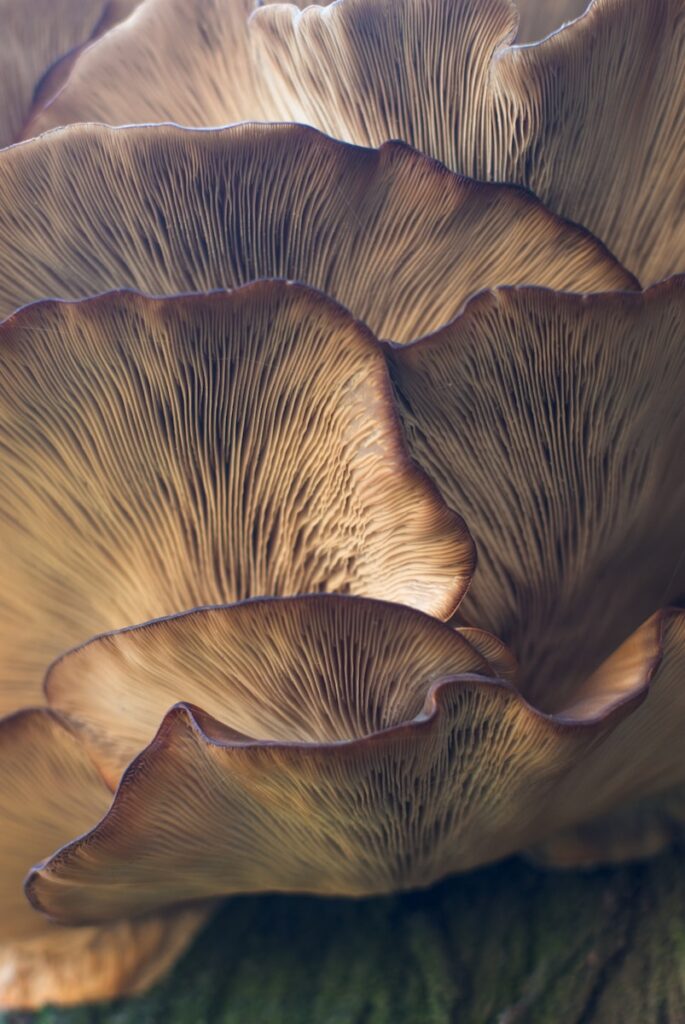
The cap of the oyster mushroom is fan-shaped to shell-like, with a diameter of five to fifteen centimetres. The surface appears smooth, sometimes slightly wavy, in shades between light grey-beige and deep slate grey — depending on the incidence of light and ripeness.
The lamellae run fan-shaped from the base of the stem to the edge of the cap, narrowly set and whitish to cream-coloured. Fresh specimens have a certain firmness; with increasing age, the edges become wavy, the flesh softer.
Taste and aroma
Raw, the oyster mushroom has a slightly earthy, restrained aroma. When cooked, it develops a mild, nutty taste with a subtle umami note. It soaks up flavors well — butter, garlic, soy sauce, fresh herbs — while never remaining intrusive.
Compared to the more intense shiitake or the earthy mushroom, the oyster mushroom looks more elegant and restrained. Some describe it as the “blanc slate” of mushrooms: a flavor that adapts to the dish without dominating it.
Texture
The meat is firm and tender at the same time, with a slightly fibrous structure that can be reminiscent of poultry when roasted or roasted. This property makes Pleurotus a popular meat substitute in plant-based cuisine — especially the larger, full-grown hats are suitable for “pulled” cooking or as a steak substitute.
Origin and history of the oyster mushroom
Pleurotus ostreatus is a cosmopolitan. It grows naturally on all continents — in temperate deciduous forests in Europe as well as in Asian mountainous regions, North America and parts of Africa. This adaptability is also the reason why it is so easy to cultivate: it does not make any special demands on its substrate.
Millennia-old use in Asia
In China, the cultivation of Pleurotus has a verifiable history that dates back at least to the 13th century. Historical sources prove that mushrooms were cultivated on logs, a method that is still practiced today in a modified form. In Traditional Chinese Medicine (TCM), Pleurotus ostreatus has been used in various preparations — as a dry product in soups, as an extract, as part of strengthening recipes.
Japan, Korea, and other Asian cultures adopted both culinary and medicinal uses. Southeast Asian cuisine in particular integrated the oyster mushroom deeply into its everyday cuisine.
Arrival in Europe
In Europe, Pleurotus ostreatus did not become a cultivated plant until the early 20th century. In 1917, the German botanist Ferdinand Falck described one of the first targeted cultivation methods on wooden substrates — a milestone for modern mushroom cultivation. Since then, the oyster mushroom has established itself as an integral part of European edible mushroom culture.
Today, it is part of the standard offer of every well-stocked weekly market in Austria and Germany – and has long since found its way into contemporary wellness and nutrition concepts.
Nutrient profile of Pleurotus ostreatus
Pleurotus ostreatus is low in calories, rich in nutrients and contains a number of compounds that make it interesting beyond the pure edible mushroom. The following overview refers to 100 g of fresh fruiting bodies.
Macronutrients (per 100 g fresh)
- Energy: approx. 33–43 kcal
- Protein: 3–4 g — with a comparatively complete amino acid profile
- Carbohydrates: approx. 6 g
- Fiber: 2–3 g
- Fat: less than 1 g
Micronutrients and vitamins
- B vitamins: Niacin (B3), pantothenic acid (B5), riboflavin (B2) and folate in significant quantities
- Vitamin D: UV-exposed pleurotus mushrooms may contain relevant amounts of vitamin D2 (ergocalciferol)
- Potassium: good content, relevant for electrolyte balance
- Phosphorus, copper, selenium and iron in moderate amounts
Bioactive compounds
Of particular scientific interest are the polysaccharides contained in Pleurotus, most notably pleuran — a high-molecular weight beta-(1,3/1,6)-glucan, which has been the subject of numerous laboratory studies. In addition, Pleurotus ostreatus contains lovastatin (a naturally occurring statin), ergothioneine (a rare antioxidant), as well as various phenolic compounds.
Mushrooms are not plants and not animals — they are something of their own. Their nutrient spectrum follows its own logic that neither the vegetable department nor the supplement shelf fully captures.
Possible wellness effects: What research suggests
Important note: The following remarks reflect the current state of scientific research. They do not constitute medical statements and are not a substitute for medical advice. Food supplements are not a substitute for a balanced diet.
Immune system
Beta-glucans from Pleurotus — especially pleuran — have been studied in various laboratory studies and animal experiments for their interaction with the immune system. Studies indicate a possible immunomodulating effect, i.e. regulation instead of one-sided stimulation. Meaningful human clinical trials on a larger scale are still pending.
Antioxidant Capacity
Pleurotus contains ergothioneine, a sulfur-containing amino acid with antioxidant properties that the human body cannot synthesize on its own. Mushrooms are one of the few relevant food sources of this compound at all. Ergothioneine is intensively discussed in research as a possible cellular protective factor.
Cardiovascular system
The natural lovastatin content in Pleurotus ostreatus is the subject of basic cardiological research. Lovastatin is known as a synthetic statin for cholesterol reduction; whether the content in Pleurotus produces clinically relevant effects in everyday quantities has not yet been conclusively scientifically assessed.
Intestines and digestion
The fibre and polysaccharides of oyster mushrooms can help promote a healthy intestinal flora. Prebiotic effects of certain fungal polysaccharides are increasingly being researched, although the transfer to humans requires further study.
Inflammation modulation
Several in vitro studies have examined phenolic compounds and polysaccharides from Pleurotus for anti-inflammatory properties. The results are promising, but as with many natural product studies, the step from the laboratory to humans is complex.
How is Pleurotus traditionally used?
In Traditional Chinese Medicine (TCM), Pleurotus ostreatus was used as a tonic and to support the tendons and joints — a classification that can be traced back to the 14th century in Chinese medical literature. It was considered a warming mushroom that is said to nourish qi and blood.
Mushrooms are also found in the Ayurvedic tradition as an ingredient in strengthening recipes, although Pleurotus is less prominent there than in the East Asian medical tradition.
In Europe, the use of oyster mushrooms was historically more on the culinary side — the folk medicinal use was less systematically documented than in China or Japan. It was not until modern medicinal mushroom research, which has gained momentum since the 1970s and 1980s, that traditional knowledge was combined with scientific methods.
State of scientific research on Pleurotus ostreatus
Pleurotus ostreatus is one of the most intensively studied edible mushrooms. Research focuses on several groups of active ingredients:
Beta-glucans and immunomodulation
Pleuran, the characteristic beta-glucan of the oyster mushroom, has been studied for its immunomodulating properties in laboratory and animal studies. Clinical trials in humans — including some pilot studies with pleuran supplements for respiratory diseases — have provided initial interesting data, but require larger follow-up projects to allow valid conclusions.
Ergothioneine Research
Interest in ergothioneine as a so-called “longevity vitamin” has increased in recent years. Mushrooms in general and Pleurotus in particular are considered one of the few significant food sources. Epidemiological observations suggest that populations with higher mushroom consumption have higher serum ergothioneine levels — the causal interpretation remains the subject of ongoing research.
Antimicrobial and antifungal compounds
Pleurotus contains various proteins and peptides that have been shown to have antibacterial and antifungal effects in laboratory experiments. There is still considerable research potential here, especially in the context of resistant germs.
Extract vs. fruiting body: What makes the difference?
A central point in medicinal mushroom research is bioavailability: Certain compounds — such as high-molecular polysaccharides — are difficult for the body to access in raw or lightly cooked mushrooms. Extracts extracted from the fruiting body using standardized methods can significantly increase the concentration and bioavailability of these compounds. Liquid extracts that use dual extraction (hot and cold, with water and ethanol) are currently considered one of the most efficient dosage forms.
Pleurotus in everyday life — from the kitchen to the daily routine
The oyster mushroom is rarely a monoculture mushroom. He adapts. In the kitchen, it takes on the role of silent supporter: low in calories, high in protein, with a texture suitable for many preparations.
In the kitchen
Seared in butter with thyme and a little garlic — this is the fastest way to emphasize the nutty flavors. Larger hats can be pulled into “pulled mushroom” and used as a plant-based alternative in wraps, tacos or bowls. In Asian cuisine, it is a classic wok mushroom: hot and briefly cooked, with sesame seeds, ginger, miso.
Pleurotus is also used as a dried and ground ingredient in soups, sauces and spice blends. This intensifies the umami character considerably.
As an extract in the daily routine
Those who want to integrate the benefits of Pleurotus into their everyday lives, regardless of the amount of cooking required, are increasingly turning to standardised extracts. The organic Pleurotus liquid extract from TAOVITALIS — extracted exclusively from the fruiting body, dual-extracted, EU certified organic — can be easily stirred into water, muesli or a morning smoothie. Forty drops a day, directly into the mouth or into your favorite drink.
This dosage form has an advantage that the kitchen does not offer: consistency. Same amount of active connections, every day, without any effort.
Pleurotus in tea, coffee and cocoa rituals
The topic of mushroom extracts in drinks has long since ceased to be a niche topic in wellness-savvy circles. What was once considered an East Asian health practice has found its way into contemporary morning and evening routines — from Tokyo to Vienna.
In the morning coffee
The mild character of Pleurotus extract blends inconspicuously into black coffee or flat white. No taste of its own that disturbs. A few drops, stirred in — done. If you have a morning routine anyway, you will find a simple anchor point here.
In herbal tea
The combination with herbal teas, which themselves bring earthy or woody aromas, is particularly elegant: Roibos, Pu-Erh, Lapacho. The extract virtually disappears into the drink, but leaves its active ingredient base. In the evening, as part of a slow-down ritual, this works remarkably well.
In the cacao ritual
Ceremonial cacao with a mushroom extract — that sounds more exotic than it is. Bitter cocoa warmed with plant milk, a little cinnamon and cardamom, a few drops of Pleurotus or even the Reishi extract for the evening hours: this results in a drink that nourishes and soothes at the same time. For those who appreciate regular rituals, this format gives structure and meaning without becoming an effort.
More inspiration for daily medicinal mushroom rituals can be found in the TAOVITALIS Journal.
Storage and preparation — practical information
Fresh Pleurotus mushrooms
- Refrigerator: fresh oyster mushrooms can be kept in the vegetable drawer, unwashed, in a paper bag or on a plate of kitchen paper, usually for three to five days.
- Do not wrap: Plastic wrap accelerates sweating and mold growth. Air is better than airtightness.
- Washing: if possible, only shortly before preparation, and only briefly — mushrooms absorb water and then lose their roasting character during frying.
- Freezing: possible, but only after a short blanching or frying. Raw frozen mushrooms lose their texture almost completely.
- Drying: oyster mushrooms can be dried well in a dehydrator or oven (below 60 °C) and then processed into powder — this shape has a very long shelf life.
Pleurotus extract and supplements
- Storage: Store liquid extracts in a cool, dry place away from light. Shake well before use.
- Shelf life: according to manufacturer’s specifications; the alcohol content in the liquid extract serves as a natural preservative.
- Dosage: TAOVITALIS recommendation: 40 drops daily — taken directly or dissolved in water, muesli, smoothie.
- Regularity: As with all functional foods, continuity is more important than intensity. Daily, steady intake is preferable.
Side effects and important notes
Pleurotus ostreatus is generally considered to be well tolerated. It is consumed worldwide as a food without any relevant safety concerns being known.
Possible hypersensitivities
As with all mushrooms, hypersensitivity reactions can occur in a small minority of people — especially on first contact. People with known mold allergies should always introduce mushroom products with caution.
Spore dust
When growing or intensively handling fresh oyster mushrooms, spore dust released can cause respiratory irritation in sensitive people. As a food and in extract form, this is not a relevant factor.
Interactions
The natural lovastatin content in Pleurotus is very low; significant interactions with drugs beyond normal food intake have not been documented. However, if you regularly take high-dose extracts and take cholesterol-lowering medication at the same time, you should discuss this with a doctor.
Pregnancy and breastfeeding
As a food, Pleurotus is safe during pregnancy and breastfeeding. When taking extracts, as with all dietary supplements, it is advisable to consult a doctor in advance.
Children
Extracts should be kept out of the reach of children. As a food, the oyster mushroom is suitable for all age groups.
Food supplements are not a substitute for a balanced and varied diet and a healthy lifestyle.
Frequently asked questions about Pleurotus ostreatus
Is Pleurotus healthy?
Pleurotus ostreatus is a nutrient-dense mushroom with a comparatively high protein content, B vitamins, vitamin D and bioactive polysaccharides such as beta-glucans. It is considered low in calories and high in fiber. Scientific research is intensively investigating its immunomodulating, antioxidant and inflammation-modulating properties — but valid clinical studies in humans are still under construction. As a food, Pleurotus is a valuable part of a balanced diet.
What does Pleurotus ostreatus taste like?
The oyster mushroom has a mild, slightly nutty taste with a subtle umami note. It is restrained, absorbs flavors well and is suitable for a variety of dishes. Compared to shiitake or porcini mushroom, it has a finer taste and is less dominant.
How to use Pleurotus in everyday life?
Fresh Pleurotus mushrooms are suitable for frying, steaming, grilling and soups. As an extract, it can be easily stirred into water, coffee, tea or smoothies. Taking 40 drops of liquid extract daily is a common format for regular integration into everyday life.
Can Pleurotus be taken daily?
Yes. As a food, the oyster mushroom is ideally suited for daily consumption. As an extract supplement, it is recommended to take it daily according to the dosage indicated on the product. The recommended daily dose should not be exceeded.
What are the side effects of Pleurotus?
Pleurotus ostreatus is generally very well tolerated. In rare cases, hypersensitivity reactions may occur, especially in those with fungal allergies. In the case of existing illnesses or medication, medical advice is recommended before taking extracts.
Is there scientific evidence for the effect of Pleurotus?
Yes — there is a growing number of laboratory studies and preclinical studies investigating the immunomodulating, antioxidant and inflammation-modulating properties of Pleurotus components. In particular, beta-glucans (pleuran) and ergothioneine are the subject of active research. Large-scale clinical trials on humans are still largely lacking; the results so far are considered promising, but not yet conclusively evaluated.
Can you mix Pleurotus extract in coffee?
Yes. Pleurotus liquid extract can be easily stirred into coffee, tea or cocoa. The mild taste of the extract is hardly noticeable in coffee. The active ingredient composition is not significantly changed by the temperature in the finished beverage.
What is the difference between Pleurotus powder and liquid extract?
Mushroom powder consists of ground, dried fruiting body or mycelium — the bioavailability of the bioactive compounds is limited because fungal cell walls consist of chitin, which can hardly be digested by the body. A high-quality liquid extract extracted from the fruiting body by dual extraction (water and ethanol) dissolves these cell walls and concentrates the bioactive compounds in a form more accessible to the body.
When is the best time to take Pleurotus?
There is no scientifically proven “best time”. Many people incorporate Pleurotus extract into their routine in the morning — as an accompaniment to their first coffee or stirred into breakfast. The decisive factor is above all the regularity, less the exact time of intake.
What is the difference between oyster mushrooms and king oyster mushrooms?
Both belong to the genus Pleurotus. The oyster mushroom (Pleurotus ostreatus) grows fan-shaped on wood, has light grey caps and a mild taste. The king oyster mushroom (Pleurotus eryngii) has a thicker, fleshier stem and a more intense, nutty taste. They differ significantly in taste and texture — in terms of content, they share many characteristics.
Conclusion: A mushroom with substance
Pleurotus ostreatus is not a fashionable mushroom. It was there long before the current interest in functional foods — in Asian kitchens, in TCM, on European logs in autumn. Research has caught up with it in recent decades and is now also giving it scientific contours.
What remains: a mushroom with a remarkable nutrient profile, interesting bioactive compounds and a long history of use. Not a miracle cure. No promise of healing. But a very good reason to have it on your plate more often — or in your daily routine.
If you want to take the step from edible mushroom to concentrated extract, you will find a product in the organic Pleurotus liquid extract from TAOVITALIS that consistently originates from the fruiting body, is dual-extracted and laboratory-tested. Made in Austria, from our own breeding. Without compromise.
More about the other medicinal mushrooms in the TAOVITALIS range — including Lion’s Mane for focus, Reishi for inner peace and Shiitake for balance — in the journal and in the knowledge section.