

Supplements for Skin Ageing: What Really Helps Your Skin
There is a moment, usually somewhere in your mid-twenties, when your skin starts to react differently than it used to. A sleepless night shows more clearly the next morning. A demanding month leaves visible traces that used to simply disappear. The skin that once seemed to forgive everything begins to tell the story of how we live – and this is exactly where supplements for skin ageing come in: not as a quick fix, but as a quiet, long-term contribution.
That is no reason to worry. It is biology. And it is worth taking a closer look – not only at what we apply on the outside, but at what the body receives from within. Supplements for skin ageing are not a switch you simply flip, but they can help shape this process from the inside. Because skin ageing does not begin at the surface.
What actually happens in the skin
From around the mid-twenties, the body’s own collagen production slows down year after year. Collagen and elastin, the structural proteins responsible for firmness and elasticity, are renewed more slowly than they are broken down. At the same time, free radicals take their toll on the skin: UV radiation, fine dust, but also internal processes such as chronic stress create oxidative stress that makes cells age faster than necessary.
These processes cannot be stopped. But they can be supported – with a lifestyle and diet that give the skin what it needs for its own regeneration.
The nutrients that make a difference
Not every supplement that promises beautiful skin lives up to its claims. Anyone interested in supplements for skin ageing will, however, find a few substances that are well researched and play a plausible role in the interplay between diet and complexion:
- Vitamin C is a cofactor in the body’s own collagen synthesis and also acts as an antioxidant against free radicals. Without enough vitamin C, the body can only build collagen to a limited extent.
- Omega-3 fatty acids support the skin barrier and thus the skin’s ability to retain moisture. An intact barrier looks plumper and more resilient.
- Zinc supports cell regeneration and plays a role in wound healing and the skin’s natural renewal cycle.
- Plant antioxidants – such as polyphenols from green tea or carotenoids from berries and root vegetables – help cushion oxidative stress before it leaves visible traces.
These nutrients work best together, not in isolation. A diet rich in vegetables, healthy fats and few processed foods forms the foundation on which targeted supplements can build.
Sun protection as the foundation, not a footnote
As much as nutrients can help from within, the single biggest factor in visible skin ageing remains UV radiation. No supplement makes up for years of unprotected sun exposure. A daily sun protection factor, even on cloudy days, is therefore less an additional step than the prerequisite for all other measures to work at all. Anyone who consistently follows this one point has already done the most important thing.
What matters when choosing supplements
Not every product delivers what the label promises. With plant extracts and medicinal mushrooms, it is worth looking at origin, cultivation and processing: Does the raw material come from certified organic cultivation, was it extracted gently, and is the composition traceable? Liquid extracts often have the advantage of better bioavailability compared with capsules, as the active compounds are already dissolved. Transparency is just as important – for example through certificates of analysis or the exact origin of the mushrooms used. Quality rarely shows in the marketing, but in the details a manufacturer discloses.
The quiet connection between stress, sleep and complexion
What often gets overlooked in conversations about skin ageing: stress and sleep have as strong an effect as any food supplement – just less visibly. Persistent stress raises cortisol levels, and elevated cortisol can accelerate collagen breakdown and promote inflammatory processes in the skin.
Sleep, in turn, is the time when skin cells actually regenerate. Anyone who chronically sleeps too little or too restlessly deprives the skin of exactly the time window it needs for its own repair. In that sense, a calm evening is often more effective than the most expensive serum.
Medicinal mushrooms as underrated allies
Alongside classic vitamins, medicinal mushrooms are increasingly coming into focus when it comes to skin health from within. They do not work through a single ingredient, but through their complex interplay of beta-glucans, polyphenols and minerals.
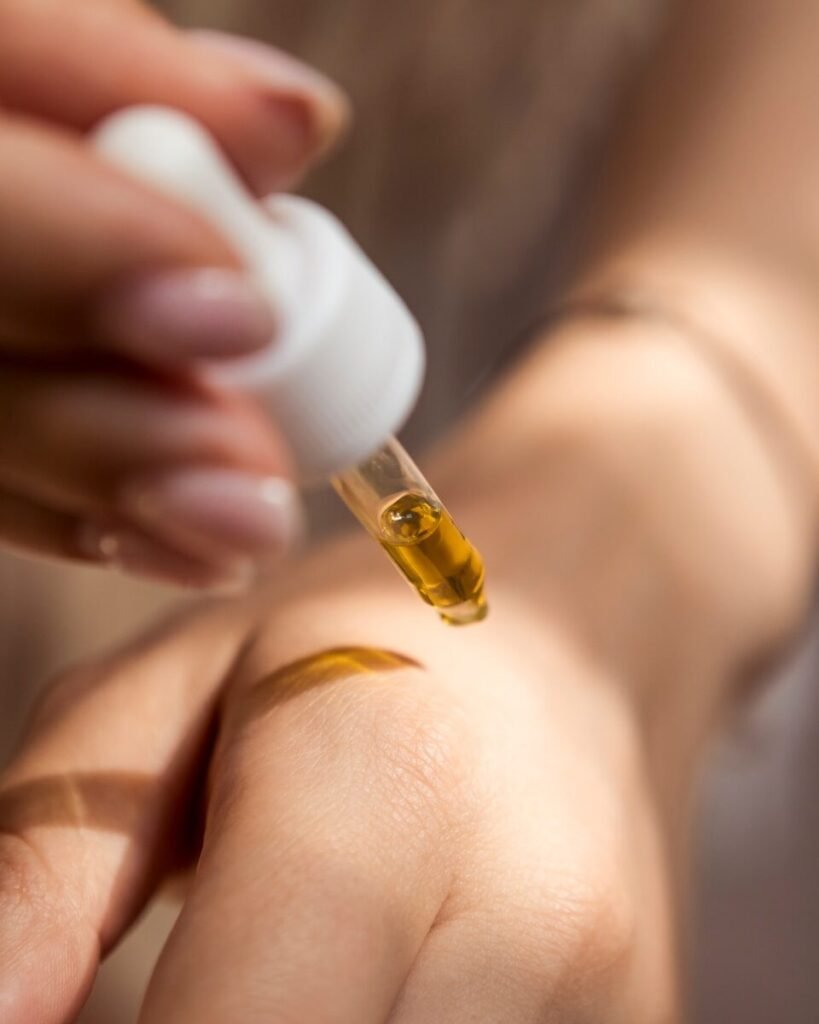
Chaga, for example, is one of the mushrooms with the highest known antioxidant content and has long been associated in traditional use with a balanced, resilient complexion. As an organic liquid extract such as TaoGut, it is easy to integrate into everyday life – for example in the morning in water or tea.
Reishi, in turn, is one of the best-known adaptogens and is traditionally used to support stress regulation. Since stress and complexion are closely linked, a calmer nervous system can indirectly benefit the skin as well. At TaoVitalis, this mushroom is available as TaoCalm in liquid extract form.
Honesty matters here: medicinal mushrooms are not miracle cures and replace neither sun protection nor a balanced diet. They are one building block among several – one that fits well into a calm, mindful daily ritual.
A ritual that fits into everyday life
Effective routines are rarely complicated. A simple approach could look like this: a large glass of water in the morning, with a few drops of chaga or reishi extract, plus a meal with fresh vegetables and a good source of fat. Drink enough during the day and, where possible, plan short breaks without a screen. In the evening, a fixed bedtime that gives the skin the regeneration it needs.
No ritual has to be perfect to work. What counts is repetition – week after week, not as a short-term cure. If you like, you can extend the ritual with a conscious break in the afternoon: a few minutes without a to-do list, in which the body is allowed to step out of the constant alarm of everyday life. That, too, is skin care in the broader sense.
Patience instead of promises
Skin changes slowly, and that is not bad news. It means that small, consistent decisions over months achieve more than any short-term measure. Nutrients, sleep, stress regulation and a mindful approach to your own body work together – quietly, but steadily.
So if you really want to do something good for your skin, you don’t have to do more, but do it more consciously. The rest is a matter of time.