
Some ingredients exist on the border between legend and reality. Cordyceps sinensis is one of them. For centuries, the fungus was known only to shepherds in the Tibetan highlands —those who observed cattle becoming unusually enduring after eating certain grasses. Today, the same organism is the subject of modern nutritional science, an integral part of functional wellness routines and one of the most discussed medicinal mushrooms in the world.
This guide answers the most important questions about Cordyceps sinensis: What exactly is it, where does it come from, what does research say — and how can it be meaningfully integrated into everyday life. Without exaggeration. With the necessary respect for an organism that is more complex than any trend.
What is Cordyceps sinensis?
Cordyceps sinensis (today taxonomically also classified as Ophiocordyceps sinensis ) is a parasitic sac fungus that grows in the field exclusively on the larvae of certain ghost moth species (Thitarodes spp.). The fungus infects the larva in the soil, overgrows it completely, and the following spring sprouts a slender, finger-like fruiting body from the frozen grasslands. This interplay of two organisms — a larva and a fungus — is as improbable as it is fascinating.
In the vernacular it is called Tibetan caterpillar fungus, in Chinese Dōng Chóng Xià Cǎo (冬虫夏草) — “winter worm, summer grass”. The name refers to its mysterious appearance: in winter a larva under the ground, in summer a fungus above it.
For trade and many research studies, the cultivated variant Cordyceps militaris is mainly used today, as Cordyceps sinensis has not yet been reliably bred on an industrial scale. Both species share important bioactive compounds, but differ in concentration and composition. High-quality products transparently indicate which type was used.
Cordyceps sinensis or Cordyceps militaris — what’s the difference?
Cordyceps sinensis is the wild form from the Himalayan highlands and is considered the original of the traditional application. Cordyceps militaris is the cultivable relative that can be grown commercially and often shows similar or higher concentrations of cordycepin in studies. Cordyceps sinensis from the open field is rare, correspondingly expensive and often adulterated on the market. If you are looking for quality, you pay attention to complete transparency with the manufacturer.
Appearance, texture and special features
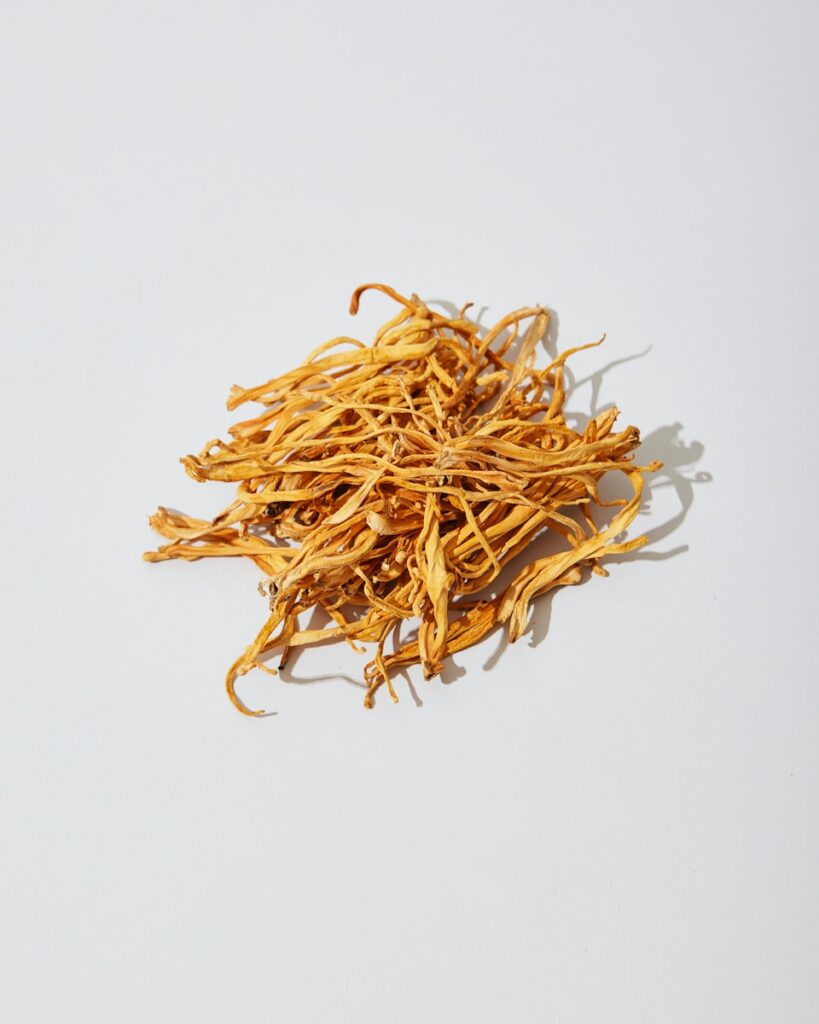
The fruiting body of Cordyceps sinensis is unmistakable: a narrow, dark brown to orange-brown stroma of two to eight centimeters in length, which grows directly from the mummified larval body. The surface is slightly rough, the consistency firm and dry. As a whole, the mushroom has something archaic about it — it looks like a small, petrified creature that is half animal, half plant.
In the dried state, which is relevant for most preparations, it has a restrained smell — slightly earthy, with a minimal warmth note. As a powder or extract, it has an almost neutral odour, which makes it easy to integrate into beverages.
Origin and History: From the Highlands to the World
Cordyceps sinensis is native to the high plateau of Tibet, Bhutan, Nepal and the provinces of Yunnan, Sichuan and Qinghai in China — regions located at an altitude of 3,000 to 5,000 meters, where the ground freezes in winter and thaws briefly in summer. It is precisely in this alternation that the fungus is formed.
The oldest written mentions in Traditional Chinese Medicine date back to the 15th century. In the 18th century, the standard medical work Bencao Congxin (New Compilation of Materia Medica) described it as a toning agent for the lungs and kidneys, suitable for exhaustion, weakness and to strengthen the vital force.
Cordyceps did not gain international attention until 1993, when Chinese track and field athletes set several world records over long distances at the World Championships in Stuttgart. Her trainer Ma Junren attributed the performances to a training program with cordyceps broth, among other things. Whether the fungus was the cause or one of many variables remained open — but interest was aroused. Since then, Cordyceps sinensis has been one of the most studied functional fungi in the world.
Even today, wild Cordyceps sinensis is one of the most expensive natural substances of all. In some years, he fetched prices in Tibetan markets that exceeded those of gold — a sign of his rarity, but also of his deep-rooted cultural esteem.
Nutrient and active ingredient profile of Cordyceps sinensis
The bioactive complexity of Cordyceps sinensis is remarkable. In addition to general nutrients such as proteins, essential amino acids, polysaccharides and trace elements, it contains several specific compounds that are the focus of research:
- Cordycepin (3′-deoxyadenosine): An adenosine analogue that is considered one of the most characteristic bioactive compounds. It is found in higher concentrations in Cordyceps militaris.
- Cordycepic acid (D-mannitol): A natural sugar alcohol found in the mushroom that has antioxidant properties.
- Polysaccharides: In particular, beta-glucans, which are discussed immunomodulatory.
- Adenosine: An endogenous nucleoside with relevance for energy metabolism and vascular function.
- Sterols: Among them ergosterol as a precursor of vitamin D.
- Nucleosides and nucleobases: A wide range of nitrogenous compounds.
The composition varies considerably depending on origin, harvest time, processing and whether wild C. sinensis or cultivated C. militaris is present. Laboratory analysis is essential for reliable statements on the concentration of active ingredients — a standard that reputable manufacturers meet.
Possible effect on well-being and health
What traditional medical systems formulated over centuries has been systematically investigated by modern science for several decades. Cordyceps sinensis is discussed in various contexts. It is important to classify these findings soberly: many studies have been conducted in vitro or on animals; clinical trials in humans are still limited. No mushroom is a cure.
Physical endurance and oxygen utilization
One of the most studied areas. Preclinical and some clinical studies suggest that cordyceps extracts may affect oxygen utilization in muscle cells — possibly via modulation of ATP metabolism. Older subjects in particular showed improvements in aerobic capacity in some studies. The results are interesting, but not conclusively proven.
Energy metabolism and fatigue
In TCM, cordyceps is classically considered a tonic for states of exhaustion. Laboratory studies suggest that the adenosine compounds they contain may play a role in mitochondrial energy metabolism. This makes it interesting for people who want to keep their midpoint better — without having to rely on stimulants.
Immune system
The polysaccharides of the fungus, especially certain beta-glucans, are being investigated in research for immunomodulating properties. This does not mean immune stimulation in the colloquial sense, but a possible support of the immune system’s ability to regulate. This area is scientifically the most advanced among functional fungi as a whole.
Kidney and Lung Health
Traditionally, Cordyceps has been used specifically to support the kidneys and lungs. Some clinical observational studies from China and Korea investigated its use in chronic kidney disease, some of which had positive results. However, these studies are not always methodologically at the level of Western evidence.
Stress regulation
Cordyceps is sometimes counted among the adaptogens — substances that could help the organism to better process physical and psychological stress. The research on this is less dense than with reishi or ashwagandha, but the traditional background is consistent.
Note: All effects mentioned here are based on animal and/or laboratory studies as well as traditional forms of use. They do not represent promises of healing. Dietary supplements are not a substitute for medical treatment.
Traditional application in Chinese medicine
In Traditional Chinese Medicine (TCM), Cordyceps sinensis is classified as warming, toning. It is considered a means of strengthening lung qi and kidney yang — concepts that in the Western understanding can best be translated as vitality, endurance and the ability to regenerate.
Classic dosage forms were the preparation as a soup with duck or chicken (the mushroom was cooked directly), as tea or pickled in rice wine. The idea has always been that the mushroom unfolds its properties best over time and in combination with food — not as a short-term one-off effect, but as part of a continuous ritual.
In Tibet, it was administered to shepherds and monks alike to support altitude endurance and to counter fatigue after long hikes. Due to its rarity, accessibility was long limited to the privileged classes; it was considered a gift to the imperial court and a luxury good of the first order.
State of scientific research on Cordyceps sinensis
Scientific research into cordyceps has gained significant momentum over the past two decades. Several hundred studies investigating various aspects of the fungus are now available on platforms such as PubMed.
Studies on sports performance
An often-cited randomized, placebo-controlled trial (Chen et al., 2010) investigated the effect of Cordyceps militaris on aerobic capacity in older adults. After twelve weeks, participants in the verum group showed measurable improvements in VO₂max and exercise tolerance compared to the placebo group. Similar studies came to comparable, although not always reproducible, results.
Immunomodulation studies
Beta-glucans from Cordyceps species have been investigated in numerous in vitro studies for their interaction with immune cells. This showed an influence on macrophage activity and NK cells (natural killer cells). In vivo studies in humans are still largely lacking to provide clinical evidence for these observations.
Cordycepin as a research object
Cordycepin is attracting particular scientific interest — among other things, because of its possible antioxidant, anti-inflammatory and antiproliferative properties. Research is most active here, but also the earliest: clinical conclusions cannot yet be drawn from the available data.
Limits of research
Many studies on cordyceps have methodological weaknesses: small sample sizes, lack of standardization of extracts, conflicts of interest in manufacturer financing. This does not mean that the results are worthless — it means that caution and differentiation are required.
Cordyceps sinensis in modern everyday life
The most elegant way to permanently integrate a functional mushroom into everyday life is the one that you don’t forget. Not because a timer reminds you of it, but because it inscribes itself into existing rituals.
Cordyceps sinensis fits well in the morning: before physical activity, as part of the first drink, as a silent preparation for a long day. This coincides with his classic direction of action — energy and endurance, not rest and relaxation. (For the evening, reishi would be the more obvious choice.)
Powder vs. extract — which is better?
Cordyceps powder consists of the dried and ground fruiting body or mycelium. It contains all the raw ingredients, but the bioavailability of individual active ingredients is limited because many compounds are trapped in the cell wall of the fungus. An extract — specifically a dual extract from water and alcohol extraction — dissolves these compounds and makes them bioavailable. This is the crucial difference that quality manufacturers communicate.
Cordyceps in tea, coffee and cocoa — daily rituals
Integration into everyday beverages is not a novelty — it has always been the most natural form of intake in Asia. Today, it complements itself with a growing culture of conscious consumption, in which what goes into the cup is taken into account.
Cordyceps in morning coffee
Coffee and cordyceps complement each other harmoniously: the mushroom can qualitatively expand the stimulating effect of caffeine without enhancing it. Some people report that the combination creates a more consistent feeling of energy than coffee alone — without the familiar midday slump. Simply add a few drops of liquid extract directly to the espresso or flat white.
Cordyceps in tea
Green tea — especially sencha or a light gyokuro — carries the earthy, restrained notes of the mushroom well. Ginger tea with cordyceps is also a combination that comes close to traditional ideas.
Cordyceps in cocoa
Ceremonial cacao and functional mushrooms share one thing in common: both are taken on purpose, both have a history as ceremonial drinks. Cordyceps in morning cocoa — with a little cinnamon, cayenne or cardamom — is perhaps the richest, fullest way to take it. A gesture that starts the day with caution.
Smoothie and Overnight Oats
If you have little time, simply add the extract to your smoothie or morning porridge. The flavor is mild enough to disappear in any form of preparation. The effect — if there is one — remains.
Storage and preparation
Dried Cordyceps sinensis should be stored in a cool, dry place away from light — analogous to other dried herbs and mushrooms. Well sealed and stored in a dark place, it will keep for several years without any significant loss of quality.
Powder should also be stored in a dark and dry place, ideally in airtight containers. Moisture is the biggest enemy.
Liquid extracts are usually naturally preserved due to the alcohol content (here: 25% vol.) and are stable at room temperature. Shake well before use. Store in a cool place after opening further extends the shelf life.
As a general rule, do not exceed the recommended daily dose. Food supplements are not a substitute for a balanced diet.
Side effects and important notes
Cordyceps sinensis is considered well tolerated by the overwhelming majority of healthy adults when taken in usual dosages. Undesirable effects are rare, but can occur in individual cases.
Possible reactions in sensitive individuals: mild gastrointestinal discomfort, especially at the beginning of intake or on an empty stomach. In such cases, it is recommended to combine the intake with a meal or to temporarily reduce the dose.
Particular care should be taken in the case of:
- Autoimmune diseases: Since cordyceps has discussed immunomodulating properties, its intake should be discussed with a doctor.
- Blood-thinning drugs: Theoretical interactions are possible.
- Pregnancy and breastfeeding: Due to a lack of safety data, it is not recommended to take it.
- Known fungal allergies: Individual reactions are possible.
In the case of existing medical conditions or drug treatment, medical advice is recommended before starting to take it.
FAQ — Frequently Asked Questions about Cordyceps sinensis
Is Cordyceps sinensis healthy?
Cordyceps sinensis is rich in bioactive compounds — including polysaccharides, adenosine derivatives, and cordycepin — and has been used in traditional Chinese medicine for centuries. Scientific studies point to various potential effects, especially in the area of energy metabolism and immunomodulation. It is not a remedy, but a functional food with an interesting active ingredient profile that is valued in many cultures. Healthy adults usually tolerate it well.
What does Cordyceps sinensis taste like?
Cordyceps sinensis has a mild, slightly earthy taste with a subtle warmth note. As an extract, it is almost neutral and barely noticeable in beverages. It is not a dominant flavor carrier — which makes it easy to integrate into coffee, tea or cocoa.
How is Cordyceps sinensis used?
The most common dosage forms are powders, capsules and liquid extracts. Liquid extracts are considered particularly bioavailable and can be easily stirred into beverages — coffee, tea, water or cocoa. As a rule, 20 to 40 drops a day are recommended, depending on the product and concentration. Important: regular, continuous intake over several weeks to enable an assessment.
Can you take Cordyceps daily?
Yes, taking it daily in the recommended dosage is considered safe for healthy adults. In traditional use, continuity has always been the basis: Cordyceps was not used sporadically, but as a long-term tonic. In case of uncertainties or underlying diseases, medical consultation is recommended.
When is the best time to take cordyceps?
In the morning — ideally before or with a meal and, if sports activity is planned, 30 to 60 minutes before training. Cordyceps is traditionally associated with energy rather than sleep promotion, which is why taking it in the evening is less obvious. Reishi is better suited for the evening.
What are the side effects of Cordyceps sinensis?
Side effects are rare in healthy adults. Occasionally, users report mild digestive problems at the beginning, which can be remedied with a meal or by reducing the dose. Contraindicated in autoimmune diseases (without medical consultation), blood thinning therapy as well as pregnancy and breastfeeding.
Is there scientific evidence for the effect of cordyceps?
Yes, there are a growing number of studies — both preclinical (cell and animal studies) and initial clinical trials in humans. Effects on aerobic capacity in older adults as well as immunomodulating properties of the polysaccharides contained have been particularly well studied. The evidence is promising, but not yet conclusive. High-quality, double-blind, placebo-controlled studies with large samples are largely lacking.
Can cordyceps be combined with coffee?
Yes, and this combination is popular. Cordyceps hardly changes the taste of coffee — especially as a liquid extract. Many users appreciate the combination because it describes a more even feeling of energy throughout the morning. Simply add a few drops directly to the coffee. No known interactions between cordyceps and caffeine.
What is the difference between cordyceps powder and cordyceps extract?
Powder contains the entire ground mushroom, but many bioactive compounds are poorly bioavailable due to the cell wall structure (chitin). An extract — specifically a dual extract of water and alcohol extraction — breaks down these compounds and makes them accessible to the body. High-quality extracts are more concentrated due to this process and are usually more effective than raw powder for the same amount.
What is the difference between Cordyceps sinensis and Cordyceps militaris?
Cordyceps sinensis is the wild species from the high altitudes of the Himalayas, which has not yet been reliably cultivated and is correspondingly rare and expensive. Cordyceps militaris is cultivable, often contains higher concentrations of Cordycepin according to current research and is the starting material for most commercial extracts. Both types are often discussed together in the literature; high-quality products clearly name which type was used.
Conclusion: A mushroom with history and substance
Cordyceps sinensis is not a trend. It is one of the oldest and most deeply rooted functional organisms in the East Asian medical tradition — and at the same time an active field of research with growing scientific attention. The combination of both perspectives is what makes it so interesting.
What it certainly is: complex. In its origins, in its biology, in its active ingredient profile. What it may be: a useful companion for people who understand their body as a system that can tolerate regular care — no short-term interventions.
The wisest way to deal with cordyceps is those who respect traditional wisdom, read scientific evidence soberly and take their own observation seriously. No mushroom in the world replaces sleep, exercise and good nutrition. But some mushrooms can — with consistent, informed use — help to keep one’s own balance more stable.
If you want to learn more about the world of medicinal mushrooms, you will find further texts on Reishi, Lion’s Mane, Chaga and other mushrooms that accompany modern wellness practice in the TAOVITALIS Journal. Questions about intake, products and quality standards are also answered in the TAOVITALIS FAQ.
This article is intended for general information and knowledge transfer. It does not constitute medical advice and does not replace the advice of doctors or pharmacists. Food supplements are not a substitute for a balanced, varied diet and a healthy lifestyle.